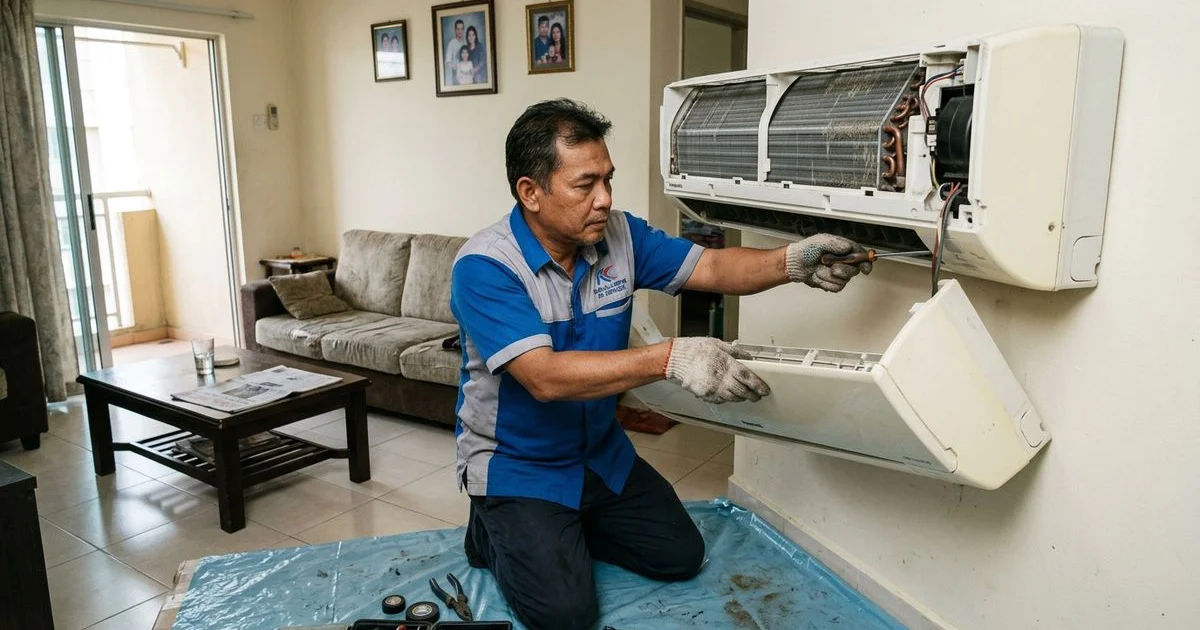
The first thing a careful technician does on any service call is read the nameplate sticker on the outdoor unit. Not the model number. The refrigerant type. Get that one detail wrong and you can turn a RM150 top-up into a RM2,000 compressor replacement on the same afternoon.
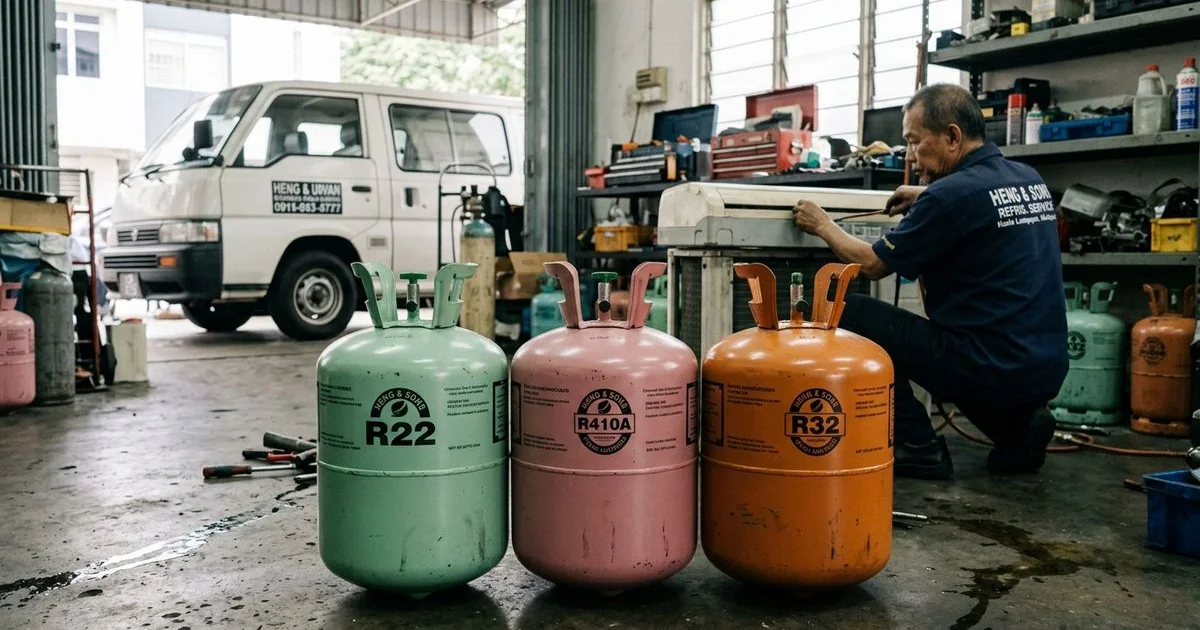
Three refrigerants dominate the residential market in Subang Jaya: R22, R410A, and R32. They look almost identical in the cylinder but they behave completely differently, and mixing them is one of the fastest ways to wreck a perfectly healthy compressor. This guide walks you through how to identify yours, what each one costs to top up, and why the chronic “just keep adding gas” approach is a money pit.
Start Here: Read the Nameplate
The outdoor unit carries a metal nameplate, usually on the side panel, with a line labelled “Refrigerant” or “R-Type”. On most Daikin and Panasonic units this is stamped or printed near the service valves, so even after years of haze and rain it is usually still legible.
If the sticker on your unit has faded, you have a few fallback options:
- The indoor unit cover sometimes carries a smaller label on the back panel
- The original purchase invoice or user manual lists the gas
- Age is a reliable hint, with very few exceptions
Send us a clear photo on WhatsApp and we can usually identify the gas from the nameplate or compressor model alone before the visit.
The Three-Era Timeline
Match your installation year to one of these eras and you will know the answer 95 percent of the time.
| Era | Gas | Notes |
|---|---|---|
| Pre-2010 | R22 | HCFC, ozone-damaging, being phased out |
| 2010 to 2018 | R410A | HFC, ozone-friendly but high GWP |
| 2018 to today | R32 | Single-component HFC, lower GWP, higher efficiency |
Why You Cannot Substitute One for Another
The first question customers usually ask is why the technician cannot just use whatever cylinder happens to be in the van. There are three hard reasons, all rooted in physics rather than convenience.
- Pressure mismatch. R410A runs at 50 to 70 percent higher operating pressure than R22. Pumping R410A into an R22 system will rupture flare joints and stress the weaker copper.
- Oil incompatibility. R22 compressors use mineral oil. R410A and R32 require synthetic polyolester (POE) oil. Mix the two and you create a thick sludge that seizes the compressor within weeks.
- Charge weight. Each gas needs a different mass for the same cooling output. Eyeballing it is not an option, even for an experienced installer.
Any technician willing to “just top it up” without verifying the refrigerant type is a technician you do not want touching your unit.
R22: The Ageing Workhorse
If your aircond is more than a decade old and has never been replaced, it is almost certainly running R22. Malaysia is actively phasing this gas out under the Montreal Protocol, with the Department of Environment targeting a complete ban by 2030. Import quotas are already pushing the price up. What used to cost RM60 a top-up five years ago can run past RM160 today, and the next two years will only sharpen the climb.
Our honest recommendation: if your R22 unit needs any major repair beyond a small flare reseal, it is time to upgrade. The electricity savings on a modern R32 inverter recover the swap cost within three to four years.
R410A: The Bridge Generation
R410A replaced R22 from roughly 2010 onward. Most non-inverter and early inverter splits sold during that window ran on R410A, including the popular Daikin and Panasonic lines that dominated the new condo handovers around USJ and Bandar Sunway. R410A is ozone-friendly but has a Global Warming Potential of 2,088, which is actually higher than R22. The industry has already started phasing it out in favour of R32.
R32: The Current Standard
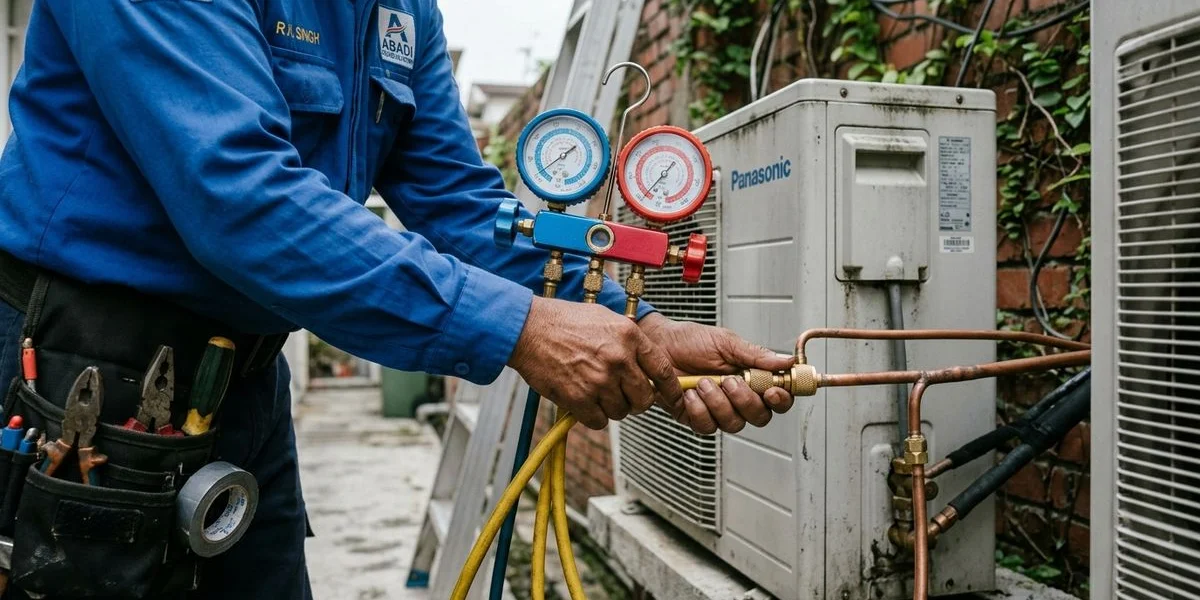
Single-component HFC refrigerant, rolled out across Malaysia from 2018 onward. Every new Daikin, Panasonic, Acson, Midea, and York split unit sold today uses R32. The real selling point is efficiency. R32 systems need about 20 percent less refrigerant mass for the same cooling output, and modern variable-speed designs cut energy consumption noticeably compared to older fixed-speed units.
Realistic Top-Up Pricing
These ranges reflect what AC Service Pro Subang Jaya quotes today for residential units between 1.0 and 2.5 HP. Larger commercial systems and ducted installations sit outside the range.
| Refrigerant | Top-Up Range | Availability |
|---|---|---|
| R22 | RM80 to RM160 | Restricted, prices climbing |
| R410A | RM100 to RM180 | Stable for now |
| R32 | RM130 to RM180 | Standard, widely stocked |
The “Just Top It Up” Trap
Read this section twice. It is the most expensive misconception in residential cooling.
Refrigerant does not run out in a healthy aircond. The gas circulates in a completely sealed loop, and a properly installed unit will hold its full charge for the entire ten-to-fifteen year lifespan of the compressor. If your system is low, there is a leak somewhere. A loose flare connection, a corroded section of pipe behind the wall, or a failing service valve. Topping up the gas without finding and sealing the leak buys you a few weeks of comfort and absolutely nothing else.
Our standard procedure on every gas service:
- Pressure test against manufacturer specification
- Electronic leak detection using a refrigerant sniffer or a bubble test on suspected joints
- Repair by soldering, replacing the damaged section, or re-crimping the flare
- Vacuum the system to remove air and moisture
- Recharge by weighing in the exact specified mass of the correct gas
- Run test for at least 15 minutes to verify pressures and cooling
Skip any of those steps and you are throwing money straight into the leak.
When a Bundled Service Makes Sense
If your unit is overdue for cleaning and also running low on gas, book a chemical wash rather than a standalone top-up. Every chemical wash from our team includes up to 10 kg of refrigerant charge at no extra cost, which covers a full recharge for almost every residential unit in the area. You walk away with a deep clean and a sealed system in a single visit, and save RM80 to RM250 in the process.
Book a Diagnostic
If you suspect a leak or simply want to know which gas your unit takes before you commit to a service, WhatsApp us at 016-636 6769 with your unit’s HP rating, brand, and approximate age. We will quote a fixed price and confirm a same-week slot. More details on the gas top-up service page.